Introduction: The most important role of the gearbox in the operation of the oil separator
An oil separator (oil-water separator) is a key component in industries such as petrochemicals, steel, food processing, and wastewater treatment. In these systems, the gearbox serves as the main drive and plays a crucial role in the efficiency and lifespan of the system. Selecting the right gearbox can increase system efficiency by up to 40% and reduce maintenance costs by up to 30%.
Types of oil separators and the role of the gearbox in the respective systems
1. Belt oil separator
-
The function of the gearbox is to control the speed of the belt.
-
Required technical specifications :
-
High torque when starting off
-
Adjustable speed from 3 to 15 rpm
-
Possibility of 24-hour operation
-
2. Cylindrical skimmer for oil separation
-
Function of the gearbox : uniform rotation of the cylinder.
-
Required technical specifications :
-
High speed accuracy (±0.5 rpm)
-
Impact resistance
-
Constant torque at different speeds
-
3. Disc skimmer for oil separation
-
Gear function : Synchronous rotation of the discs.
-
Required technical specifications :
-
Precise alignment of the discs
-
Precise speed control
-
Corrosion resistance
-
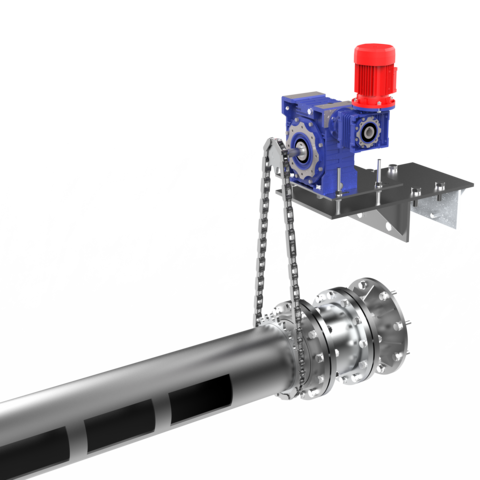
The main components of the oil separator gearbox and their functions
1. Electric motor:
-
They are typically AC devices with a power output of 0.25–2.2 kW.
-
Base speed 1400-1500 rpm
2. Circulatory reduction system:
-
Spur gears or sun gears
-
The translation ratio is usually between 1:10 and 1:50.
3. Output column:
-
Stainless steel 304 or 316
-
Mechanical seal
-
Waterproof bearings
4. Cooling system:
-
Cooling fins on high-speed models
-
Cooling oil in industrial models
Factors that influence the selection of the appropriate gearbox
1. Environmental conditions:
-
Operating temperature (usually from -10 to +60 degrees Celsius)
-
Moisture and contact with water
-
Presence of corrosive fumes
2. Technical specifications:
-
Required torque (usually 50-500 Nm)
-
Operating speed (3-30 rpm)
-
Operating mode (continuous or intermittent)
3. Economic considerations:
-
Initial purchase price
-
Maintenance costs
-
Productive life
Technical calculations for gearbox selection
1. Let’s calculate the required pair:
T = (P × 9550) / n
-
T: Torque (Newton meters)
-
P: Engine power (kW)
-
N: Output speed (rpm)
2. Let’s calculate the gear ratio of the transmission:
i = n_entrada / n_salida
-
i: Discount percentage
-
n_input: Input speed
-
n_output: Output speed
3. Service staff:
SF = (Required temperature × K) / Nominal temperature
-
SF: Safety factor (usually 1.2–1.5)
-
K: Coefficient of operating conditions (1.1-1.3)
Common problems with gearboxes with oil separators and their solutions
1. High temperature:
-
Causes : Insufficient lubrication, overloading
-
Solution : Check oil level, reduce load.
2. Oil leak:
-
Reasons : Wear and tear of the seal, damage to the seal.
-
Solution : Replace the seal and use high-quality seals.
3. Noise and vibrations:
-
Reasons : Bearing damage, shaft misalignment.
-
Solution : Balance the shaft and replace the bearings.
4. Reduced efficiency:
-
Reasons : Wear and tear of the gears, changes in oil viscosity.
-
Solution : Change the oil and check the gearbox.
Comparison of the gearbox types used
| Gear type | Advantages | Defects | Inquiry |
|---|---|---|---|
| spiral | Quiet operation, high efficiency. | relatively high costs | Large industrial oil separators |
| Solar energy | Small size, high torque | comprehensive reforms | Models with limited space |
| Qatar | Affordable price, easy repair. | More noise | Small and medium models |
| planetary | even load distribution | High construction costs | sensitive and precise systems |
Preventive maintenance of the oil separator gearbox
Scheduled maintenance program:
-
Daily :
-
Check oil level.
-
Operating temperature control
-
I hear unusual noises.
-
-
Monthly :
-
Check seals
-
Check screws and fittings.
-
Checking the condition of the bearings
-
-
Annually :
-
Complete oil change
-
Checking the gears
-
Calibration of the control system
-
Important points regarding lubrication:
-
Use the appropriate oil (usually ISO VG 150-220).
-
Oil change every 2000–4000 operating hours.
-
When selecting the oil, the ambient temperature must be taken into account.
New technologies in gearboxes for oil separation
1. Intelligent transmissions:
-
Equipped with temperature and vibration sensors.
-
Possibility of connection to monitoring systems
-
Error warnings
2. Modern materials:
-
Use of composite materials in the automotive industry
-
Anti-corrosion nanocoatings
-
ceramic bearings
3. Improved designs:
-
Reduction of internal friction
-
Increase efficiency by up to 95%
-
Reduction of energy consumption
Calculating the ROI of a high-quality gearbox
Cost comparison:
| Teacher | conventional gearbox | High-quality gearbox |
|---|---|---|
| Initial costs | 10-15 million | 20-30 million |
| Average life expectancy | 2-3 years | 5-7 years |
| Annual maintenance costs | 3-4 million | 1-1.5 million |
| Production has been discontinued. | additionally | fewer |
Calculation of the return on capital:
-
Reduction in maintenance costs: 2.5 million per year
-
Reduction of production downtime : equates to 1-2 million per year
-
Return on investment in 3-4 years
Standards for gearboxes with oil separators
-
ISO 6336 : Calculation of the load-carrying capacity of gears
-
AGMA 2001 : Gearbox design standard
-
DIN 3990 : Calculation method for gearboxes
-
ISO 4406 : Oil purity category
Conclusion: Why is a high-quality gearbox important?
The gearbox plays a crucial role in the oil separator, and choosing the right type has direct implications for the following:
-
System efficiency : highly efficient oil separation
-
Operating costs : Reduced energy consumption and lower maintenance costs.
-
Device lifespan : Prevents premature failure
-
Product quality : More efficient separation of oil and water.
Given the demanding operating conditions of oil separators (constant contact with water, oil, and chemicals), purchasing a high-quality gearbox made of durable materials with an optimized design not only saves costs but also significantly increases system reliability. Gearbox selection should be based on precise technical calculations and take into account the specific requirements of each project.